

a Change in
Conversation
The podcast that transforms tech resistance into user adoption
Are you leading a complex tech transformation across multiple countries and functions, struggling to engage all your key stakeholders?
Are you looking for the hook that will get people to see business value behind your tech change?
Are you wondering how to make your project stand out in a noisy workplace?
You're in the right place.



The podcast for anyone in the trenches of a tech change, from CIO’s to IT leaders and project managers.
No matter if you're launching an ERP system, rolling out a new HR system, or aiming to boost AI usage in your organisation, “A Change in Conversation” will inspire and activate you to launch tech with minimal noise and maximum adoption.
Complete Project Cycle Coverage
Get practical tools and tips for every stage of your tech transformation - from initial strategy and stakeholder alignment through rollout execution to measuring adoption success.Profile-Raising Strategies
Learn the strategies that will get your project the profile and visibility it deserves.Insights and Inspiration
Receive insights gained from more than 25 years in leading large scale tech change to inspire you with your own project.
If you've ever wished a project had run smoother, earned more support, or delivered more visible impact — start here.
Ready to turn your tech change into a movement? Listen in…
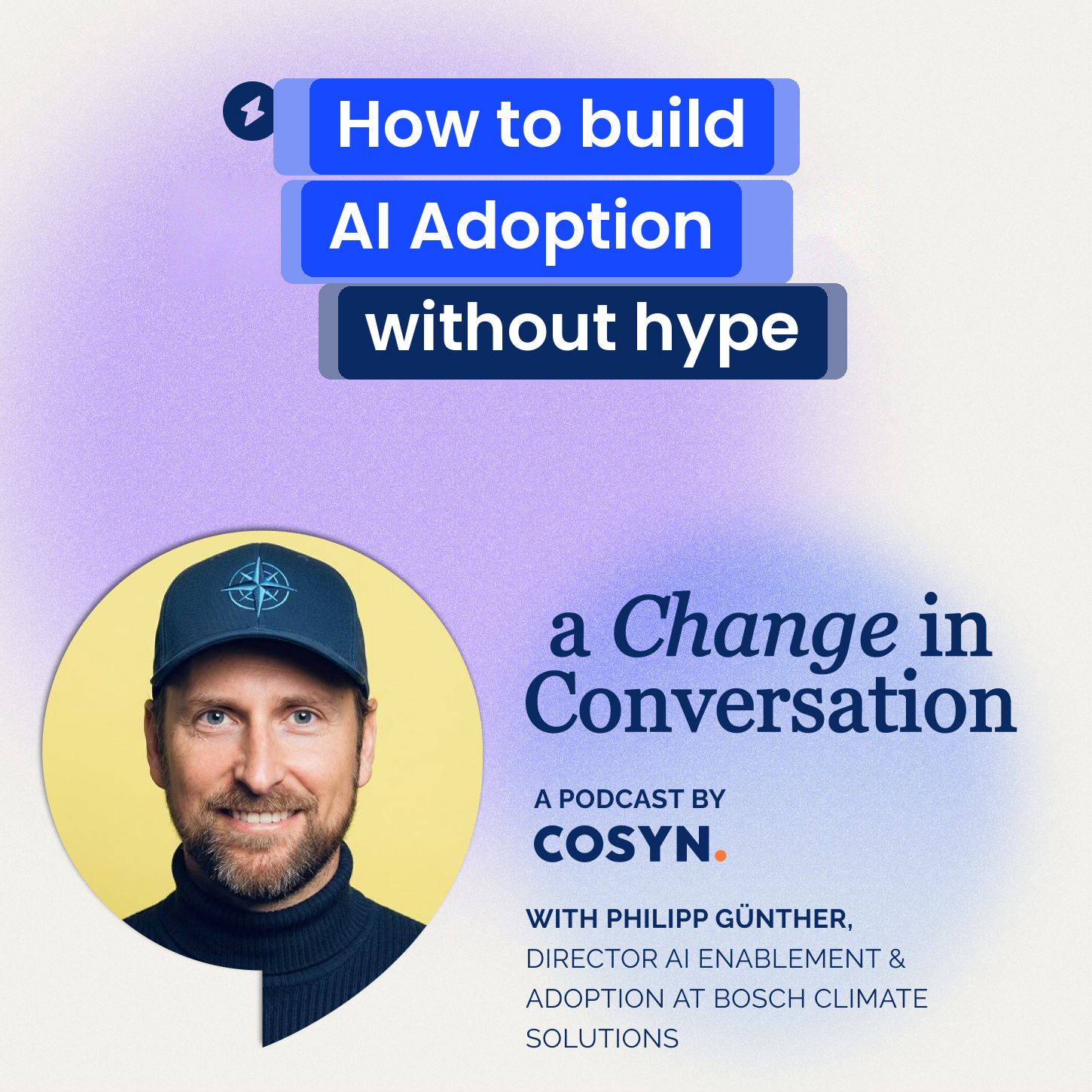
#[18] How to build AI adoption without hype | Philipp Günther (Bosch Climate Solutions)
In this episode, Bosch’s Philipp Günther makes a clear case: sustainable AI adoption is not solved by newer models. It depends on where leaders place attention, time, trust, and resources. We discuss how Bosch identifies high-value use cases, builds trusted ambassador networks, creates low-barrier formats for employees to experience AI in action, and assesses AI ROI. For the C-suite, the lesson is clear: broad adoption requires focus, ongoing mobilisation, and leaders willing to get their own hands dirty.
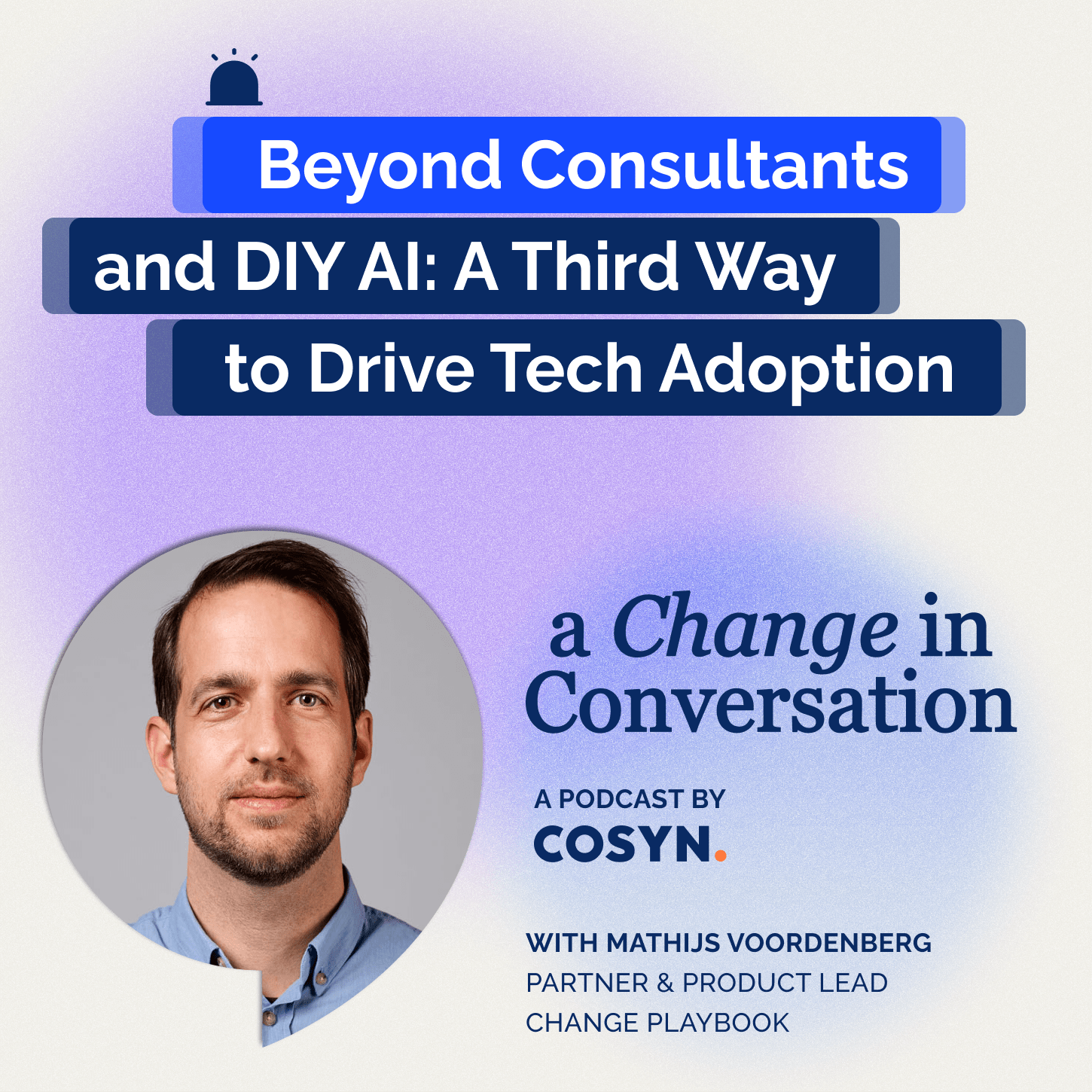
#[17] Beyond consultants and DIY AI: A third way to drive tech adoption
CIOs and Digital Transformation Leaders face intense pressure to deliver technology faster and cheaper. To drive adoption, leaders often choose between slow, expensive consultants or fast, context-blind AI. Both jeopardize your program's ROI. In this episode, Arne and Matthijs break down a smarter third way. Learn how to empower your internal teams to build an end-to-end adoption strategy in-house. Discover how software-augmented frameworks combine expert guidance with efficiency to secure lasting behavioral change.

#[16] 4 things CIOs must get right to build influence
AI has put IT at the centre of business change. In this episode, we explore four things CIOs must get right to turn that moment into influence: strategic clarity, stakeholder trust, adoption, and value storytelling. The risk is clear: if IT remains seen as an operational provider, it may miss its chance to become the strategic guide the business now needs.

#[15] Building trust with credibility:How to move IT from firefighting to trusted business partner/Linda Söderberg (Sysmex)
Linda Söderberg shares how IT leaders can move from firefighting to trusted business partnership by reducing operational noise, creating focus, and rebuilding credibility with the business. She explains why strong IT leadership starts with stabilising operations, managing demand, setting clear priorities, and communicating with a customer-centric mindset. A practical episode for CIOs and IT leaders balancing steady-state operations with future growth, innovation, and rising business expectations.
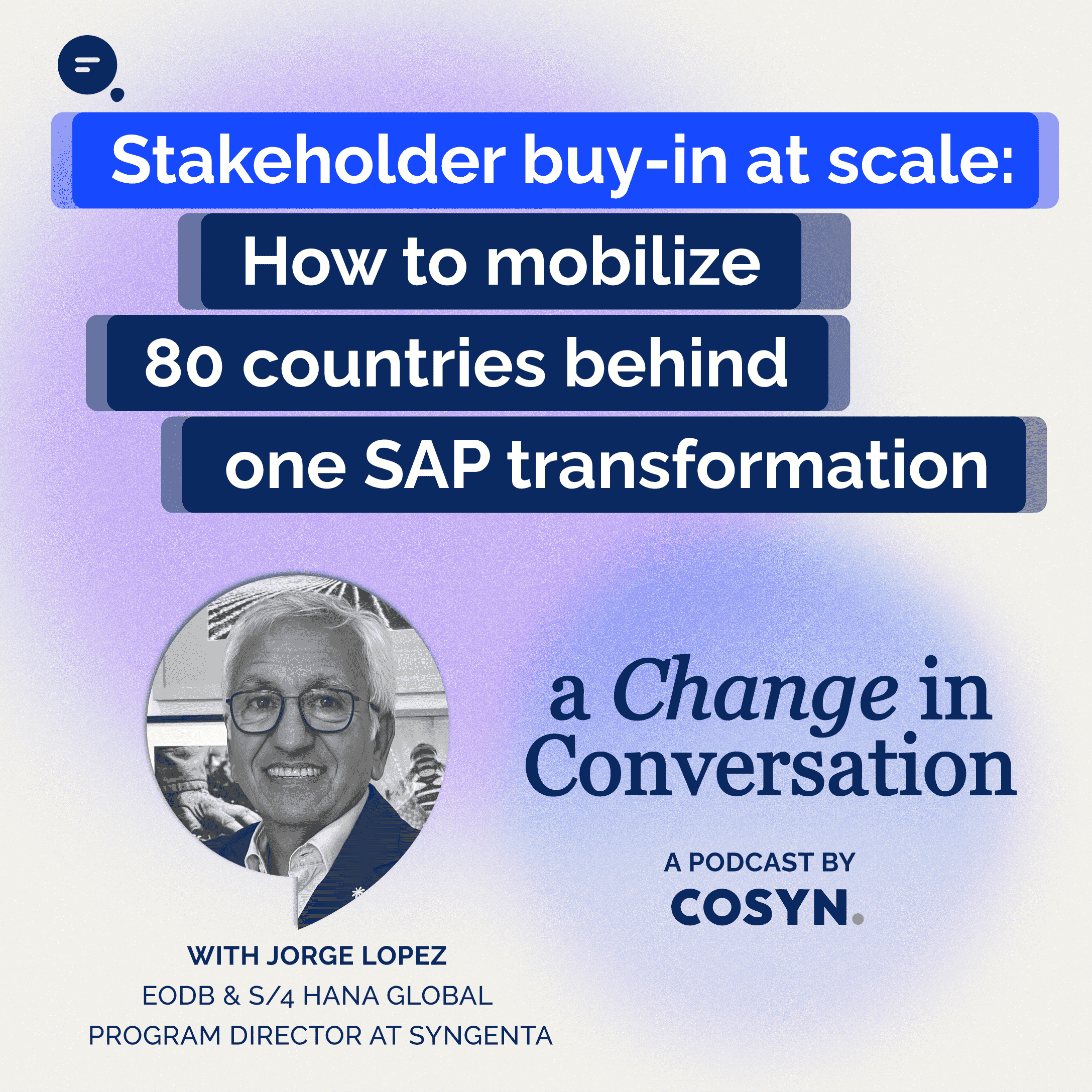
#[14] Stakeholder buy-in at scale: How to mobilize 80 countries behind one SAP transformation: Jorge Lopez (Syngenta)
In this episode, Jorge Lopez explains how Syngenta Group led a global S/4HANA rollout across 80 countries by linking the program to business value, involving regions early and building a strong cross-functional team. He shares practical lessons on governance, stakeholder alignment, standardisation versus local needs, team energy, data readiness and trusted partner collaboration. Miss these foundations, and even technically sound transformations risk slower adoption, more resistance and a harder go-live.
#[13] When to start your stakeholder engagement
In this episode, we show why stakeholder engagement in tech change must start far earlier than most programs think. Using a typical ERP lifecycle as a blueprint, we break down how to build buy-in, surface hidden concerns, manage expectations, and protect program credibility across every phase. Start too late, and resistance, weak adoption, and ROI loss become much harder to contain.
#[12] The 4 forces behind tech adoption
Go-live is not adoption. In this episode, we break down the four forces that decide whether a new technology gets used – sustainable and compliant or quietly slides into workarounds: the technology, the individual, the social layer, and the wider system around the change. You’ll learn where resistance starts, why adoption drops after launch, and what leaders can do early to protect data quality, usage, and ROI.
#[11] Why recognition is the fuel that will power your team through the ERP marathon
ERP programs are marathons. When timelines stretch over years, the risk isn't just technical – it's team burnout. This episode reframes recognition from "soft HR" to a strategic lever for sustaining momentum. Learn to avoid the "Rush & Drop" trap, embed celebration into your operating rhythm, and empower Stream Leads and Local Project Leads as recognition multipliers. Discover why building a strong "immune system" protects your delivery capacity and prevents talent churn in complex, multi-year transformations.
#[10] [Mind the gap: How to spot comms risks before they drive resistance]
Tech programs rigorously track technical risks but often ignore the "silent noise" of stakeholder resistance until it erodes adoption. This episode introduces the "Hit vs. Shit" lens—a practical framework to diagnose communication gaps before they escalate. Learn to map your rollout’s perceived gains and losses, score adoption risks like technical logs, and protect your program’s reputation. Stop reacting to noise and start managing stakeholder risk with the same rigor as data migration.
#[9] [How decentralizing comms can help to hedge local resistance]
Global programs often fail when countries treat them as distant 'HQ initiatives,' leading to low acceptance and poor user adoption. This episode explores why localisation of stakeholder engagement is strategic risk mitigation, not just translation. Learn how to activate local multipliers, replace heavy toolkits with agile 'mini-briefings,' and scale engagement without overloading your central team. Discover the practical framework to turn global noise into local ownership and buy-in.
#[8] [How to find the sweet spot on visibility for your IT program]
Many IT programs struggle to secure stakeholder buy-in because they don’t get the right level of visibility – sharing too much, too early, or too late. Inside the organisation’s attention economy, your tech program competes with every other initiative for airtime and leadership focus. This episode shows how to find the right tone and timing and build momentum deliberately so your program cuts through the noise. Get practical guidance to ensure lasting user adoption and protect the reputation of your IT investment.
#[7] [How the ghosts of projects past shape adoption before you even start]
Many programs struggle with stakeholder buy-in not because the technology is weak, but because past failures shape how people respond before rollout even begins. In this episode, we break down the three patterns of “change heritage” that trigger early resistance, reduce engagement, and erode trust. You’ll learn how to diagnose initiative fatigue, burned terminology, and trust debt—and how to address them early to protect adoption, credibility, and ROI in your current program.
#[6] [Why your Why is everything]
Many tech programs have a solid plan for the “what” and “how” — but a weak or missing “why”. This episode explains why a clear business ‘why’ isn’t a nice-to-have but a practical requirement for alignment, momentum, and stakeholder commitment in long programs like SAP or ERP. You’ll learn what makes a strong why, what happens when it’s missing, common pitfalls, and concrete steps to build a message that holds support when challenges hit.
#[5] [Why understanding your stakeholder is the key to fixing tech resistence]
In this episode, we break down why superficial stakeholder analysis creates avoidable surprises, noise, and late-stage resistance in tech programs. You’ll learn the two common failures teams overlook, and a practical three-step approach to spotting hidden concerns early. We show how to map the full stakeholder ecosystem, assess impact with clarity, and profile critical groups so you can prevent resistance before it escalates and protect the brand of your program.
#[4] [Discover the early-warning system every IT leader needs before go-live]
Most tech programs fail not because the system is wrong, but because misalignment goes unnoticed until it’s too late. In this episode, Arne explains why structured, ongoing dialogue is your most reliable early-warning system when it comes to multi-year and multi-stakeholder tech transformation. You’ll learn how to surface hidden stakeholder risks, understand the rational resistance of line managers, and combine qualitative and quantitative insights to react fast and targeted and hence avoid reactive “reputation firefighting”. Practical guidance for IT leaders who want fewer surprises and a stronger path to go-live.
#[3] [The art of positioning your change to deliver buy-in, not resistance]
Most tech programs unintentionally damage adoption by either overselling benefits or underselling the purpose. Overpromising creates disappointment when users experience turbulence at go-live; underselling makes the program invisible in a crowded internal environment. This article breaks down why expectations drive stakeholder behaviour, how to assess your true change impact, and how to set a narrative that protects adoption and ROI. You’ll learn a practical way to position your program with credibility — without noise, hype, or generic vendor messaging.
#[2] [The three common blind spots that could derail your ERP comms strategy]
Even well-structured programs face adoption risk when leaders treat each rollout as a fresh start. Employees don’t. They carry the memory of previous failures, current stress levels, and unclear strategic narratives into every new initiative.
This article breaks down three common blind spots—history, context, and strategic alignment—that consistently undermine ROI, regardless of platform or sector. If you recognise these patterns early, you protect adoption, reduce stakeholder risk, and spare your program from preventable credibility damage.
#[1] [Five comms strategies to guarantee your most successful ERP launch ever]
ERP outcomes vary widely between organisations using the exact same technology. The difference is not the system — it’s the human dynamics underneath the change. Legacy attachment, local power, team energy, cognitive overload and expectation gaps shape testing quality, data discipline, alignment and adoption. This episode explains why these forces matter, why leaders often underestimate them, and how early attention to human dynamics protects both your programme and your ROI.
#[0] [The school for stakeholder engagement IT leaders]
Technical readiness does not equal user readiness. In this inaugural episode of “A change in conversation”, we explore why ignoring stakeholder dynamics leads to expensive shelfware, cost overruns, and reputational damage for program leaders. We outline how to shift from "change management theatre" to engineered adoption that secures your investment, moving beyond the technical "go-live" to ensure actual business value is realized.

About your host
Arne Kötting founded COSYN after years of seeing organisations struggle with the human side of tech change.
He built the Change Playbook to codify what actually works — based on 20 years of watching these patterns. The Change Playbook is designed for IT program teams to confidently manage the human side of tech change in-house, without expensive consulting dependencies.
His conversational style cuts through complexity to reveal the fundamental principles that make tech change communication work—principles you can apply 1:1 to your own transformation challenges.