Episode #18: How to build AI adoption without hype | Philipp Günther (Bosch Climate Solutions)
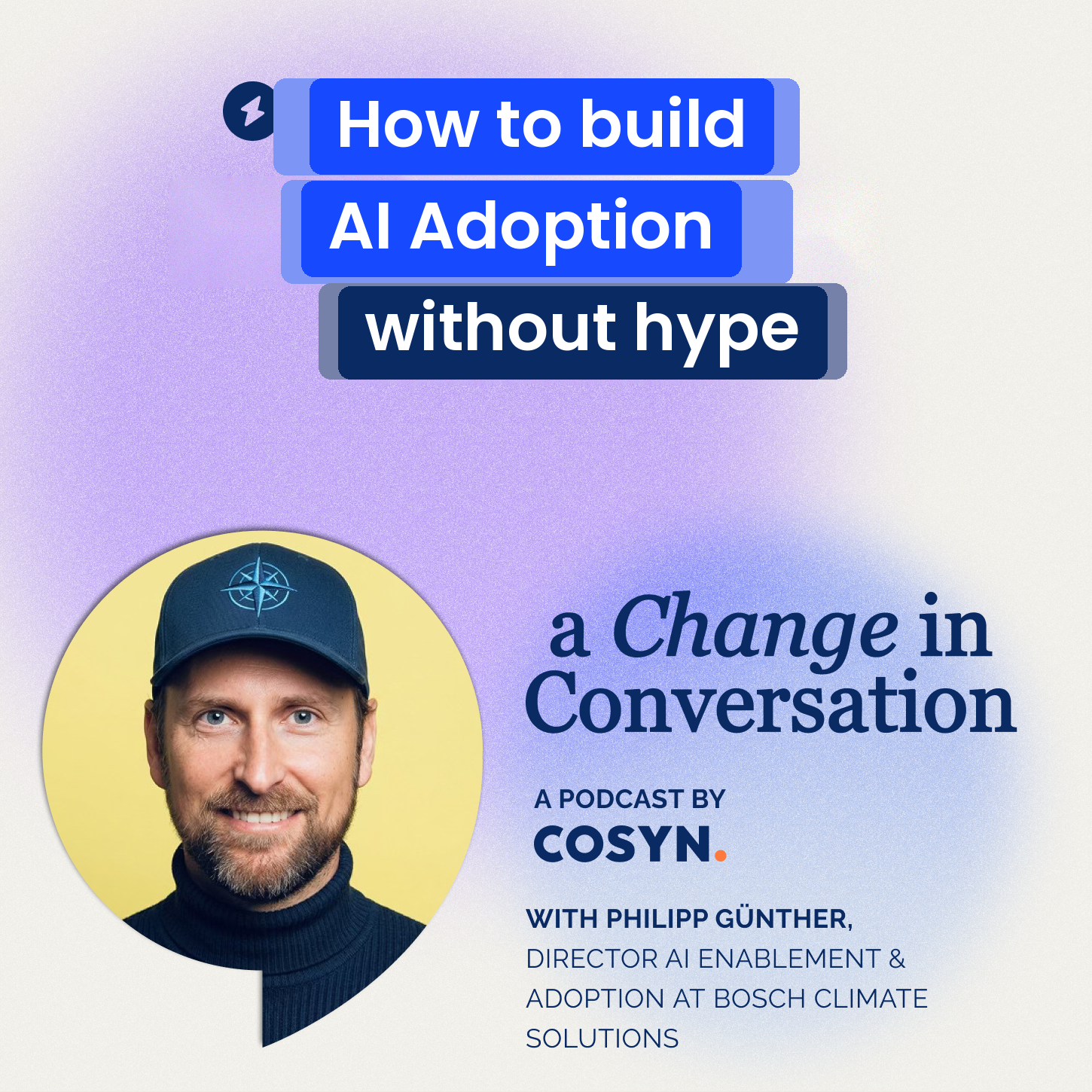
Philipp Günther, Director AI Enablement & Adoption at Bosch Climate Solutions, on how to turn AI curiosity into real usage, leadership role modelling, and measurable business value.
How to Build AI Adoption Without Hype
AI adoption is not won by buying the newest model. It is won when people across the organisation understand where AI helps, feel safe enough to try it, and have enough practical experience to use it in real work.
That was one of the strongest messages from our conversation with Philipp Günther, Director AI Enablement & Adoption at Bosch Climate Solutions. The episode is a useful reality check for C-Suite, AI leaders, and transformation teams under pressure to turn AI investment into measurable value.
AI Adoption Is Not a Tool Rollout
Many AI programmes start with the same assumption: provide the tool, run the training, send the communication, and usage will follow.
Philipp challenges that logic clearly.
The problem is not that organisations lack AI tools. Most large organisations are already surrounded by them. The problem is not even a pure lack of information. In many companies, people are already flooded with AI updates, internal channels, learning formats, vendor content, and headlines about what AI will supposedly do next.
The real challenge is different: people need to move from passive awareness to confident use.
That is not a rational information problem. It is a human adoption problem.
People need to know what is allowed. They need to understand where AI is useful in their own work. They need to see credible examples from people they trust. They need time to experiment without feeling exposed. And they need leaders who do not just sponsor AI from a distance, but show that they are learning as well.
For C-suite leaders, this matters because the cost of low adoption is no longer theoretical. AI licenses, productivity tools, internal platforms, enablement teams, and advisory spend all need to translate into business value. But Philipp also makes an important counterpoint: at user level, the ROI threshold can be surprisingly low. A €20 monthly license may equal “three meals at the canteen” or roughly half an hour of employee time. With the right adoption strategy, it does not take a dramatic productivity gain to justify the investment.
The real risk is not that AI ROI is impossible to achieve. The real risk is that organisations make it harder than necessary by treating adoption as access, training, and governance – instead of trust, practice, relevance, and leadership attention.
Better Models Do Not Automatically Create Better Adoption
A recurring theme in the conversation is the danger of chasing the newest model while underinvesting in actual usage.
Philipp makes an important distinction. In some technical use cases, better models may directly improve performance. But when the goal is broad adoption across people and teams, the bottleneck is often not model capability. It is the organisation’s ability to absorb, apply, and scale new ways of working.
That distinction is critical.
If the AI programme is treated only as a technology upgrade, leaders may keep asking the wrong question: “Do we have the best tool?”
The more useful question is: “Are people actually changing how work gets done?”
That includes small behaviours. Preparing meetings differently. Drafting faster. Testing ideas. Summarising information. Challenging AI output critically. Using internal knowledge more effectively. Asking better questions. Sharing what worked and what failed.
These are not dramatic moments. But they are where adoption becomes visible.
And they matter because today’s small habits become tomorrow’s organisational capability. As Philipp argues, the companies that build experience now will be better positioned in three years, when everyone can buy similar tools from the same vendors. The advantage will come from internal knowledge: people who have learned, tested, adapted, and understood how to apply AI to their own work.
Leadership Has to Get Hands-On
One of Philipp’s clearest points is that AI adoption must work from both ends of the organisation.
Bottom-up energy is essential. People close to the work will often identify better use cases than any central team could design from the top. But in a hierarchical organisation, grassroots energy needs visible permission from leadership. Otherwise, it hits limits quickly: no approved tools, no time, no budget, unclear policies, or shadow AI.
This is where leadership behaviour becomes an adoption lever.
If leaders speak about AI only in strategic language, people may see it as another executive priority. If leaders show how they use AI in their own work, including what they are still learning, the signal changes. It becomes safer for others to try.
Philipp is direct on this point. Leaders need to “get their hands dirty” and build their own understanding through use. That does not mean careless experimentation. It means responsible, visible learning.
For C-suite leaders, the implication is direct: visible leadership participation is not optional. It reduces hidden concerns, creates permission to experiment, and prevents AI from becoming something employees are told to adopt while leaders remain observers.
There is also an emotional dimension that leaders cannot delegate. People are curious, but many are also uncertain. Some worry about competence. Some worry about job impact. Some worry about doing the wrong thing. Some simply do not know where to begin.
AI adoption therefore needs more than instructions. It needs encouragement, psychological safety, and simple ways to experience AI in action.
Broad Adoption Needs Trusted Multipliers
A central team cannot create AI adoption across a large organisation alone. Bosch operates at enormous scale, and Philipp is clear that adoption cannot depend on one person or one central function.
That is why trusted internal multipliers matter.
Philipp describes the role of AI ambassadors or champions embedded in departments. The important part is not the label. The important part is trust.
The right multipliers are not simply the most technical people. They are people others listen to. They understand the work. They can explain real tasks, real constraints, and real opportunities. They are generous with knowledge. They are close enough to the daily work to make AI relevant.
For C-suite leaders, this is one of the strongest stakeholder lessons from the episode. If adoption is pushed only from the centre, it risks becoming abstract. If it is carried by trusted people inside the work, it becomes practical.
This is also why broad adoption and power users are not opposites.
Organisations need a smaller group of people who go deeper, test faster, and help others. But they also need broad participation across the organisation, because leaders cannot know in advance where the highest-value AI use cases will emerge. If adoption is limited to a small expert group, many opportunities stay invisible.
Low-Barrier Formats Reduce Hesitation
Philipp also describes formats such as AI Office Hours: open, practical sessions where people can dial in, ask questions, see what others are doing, and discuss what works or does not work.
This sounds simple. That is the point.
AI adoption does not always need another polished training programme. It often needs low-barrier experiences where people can see AI in action, ask imperfect questions, and learn from peers.
This is where behavioural science becomes practical.
People are more likely to try something new when three conditions come together: they want to do it, they know how to do it, and their environment makes it possible. In AI adoption, that means motivation, capability, and opportunity.
Motivation comes from relevance and confidence, not pressure.
Capability comes from practice, not information alone.
Opportunity comes from time, tools, permission, manager support, and safe spaces to try.
If one of these is missing, adoption slows down. Training alone cannot fix that.
That is why Philipp’s simple phrase matters: leaders need to “give trust, time, and money” to their people. Without that, AI remains something people are expected to adopt on top of an already full workload.
AI ROI Needs Judgment, Not Vanity Metrics
The episode also gets into a difficult question: how do you measure whether AI adoption creates value?
Philipp is pragmatic here. Not every AI use case deserves a complex KPI system. Some benefits are small, distributed, and hard to attribute precisely. A license may pay for itself through small time savings across meetings, summaries, drafts, analysis, and preparation.
That does not mean measurement is irrelevant. It means leaders need judgment.
Some use cases should be measured tightly, especially where AI affects high-value workflows, customer-facing activity, productivity, quality, or decision speed. But trying to measure every micro-efficiency can create unnecessary overhead and false precision.
Philipp’s point is especially relevant for C-suite decision-making. At enterprise level, the total cost can look large. If 50,000 employees receive licenses, the number becomes a major budget item. But at individual level, the return can be created through very small monthly efficiency gains.
The leadership task is therefore not to overmeasure every saved minute. It is to make sure adoption is broad enough, trusted enough, and practical enough that these gains can occur repeatedly across the organisation.
The stronger question is not: can we prove every micro-benefit?
The stronger question is: are we creating the conditions for people to use AI where it genuinely improves work?
Key Takeaways: What Leaders Should Remember
AI adoption does not mainly fail because people lack tools. It fails when they lack trust, time, relevance, and permission to use them.
The ROI case for AI can be easier than it looks at user level. A license can pay back with small, repeated efficiency gains.
Leaders need to get hands-on. People are more likely to experiment when senior leaders show that they are learning too.
Broad adoption needs both mass participation and a smaller group of power users who can move faster, test deeper, and support others.
Trusted internal ambassadors are more effective than external experts when adoption depends on daily work, local context, and peer confidence.
Listen to the Full Episode
Listen to the full episode with Philipp Günther to learn how Bosch Climate Solutions builds AI adoption beyond hype – and what CIOs, CDOs, AI leaders, and technology programme leads can apply when they need AI to move from curiosity to measurable business value.

About your host
Arne Kötting founded COSYN after years of seeing organisations struggle with the human side of tech change. He built the Change Playbook to codify what actually works based on 20 years of watching these patterns.
The Change Playbook is designed for IT program teams to confidently manage the human side of tech change in-house, without expensive consulting dependencies.
His conversational style cuts through complexity to reveal the fundamental principles that make tech change communication work - principles you can apply 1:1 to your own transformation challenges.

Get in touch
More podcast episodes from
a Change in Conversation